Saturday, February 1, 2014

Los Picos de Europa

 
7.12.2014

The first weekend in December, I ventured out to the Picos de Europa, courtesy of cousin Jorge and his wife Marivi. It was a grand day, full of nature and surprises.

The Picos is a compact range in the Cantabrian Mountains, just inland to the east of Avilés, and the mostly-limestone peaks stretch across parts of Asturias, Cantabria and Castile. They are one of the wonders of this part of Spain. When we got our first full glimpse of them, I felt like I was back in Südtirol. Our destination was Fuente Dé, in the western-most part of the Picos in Cantabria. We could not have asked for more perfect weather, bracingly cold and clear blue skies. It even had snowed that week in the high altitudes. Though our planned hike was abbreviated - we did not have gear for tromping through knee-deep snow - we were more than compensated by the magnificent winter vistas. 

After wending our way inland on a narrow road snaking through the steep foothills, we got our first full look at the Picos as we passed through the medieval town of Potes, which now is a major center of hiking and mountaineering. We stopped for a photo, and I noticed this statue of a Camino de Santiago pilgrim just across the road.


Los Picos at Fuente Dé


We caught the Teleférico de Fuente Dé (constructed in 1966, 1450m long, 753m ascent) up to the plateau.


Marivi and Jorge, at the visitor's center on the upper end of the Teleférico


We were determined to get at least a little hiking, as far as we could in the snow, and headed off across the plateau.


Marivi had brought pinchos for a snack for us, and we stopped here, with a lovely view of Peña Vieja (2614m), to eat them before heading back toward the Teleférico.


Back down to where the trees grow.

 
The first surprise (though it should not have been). As usual, Jorge had found a perfect place for our late lunch: the restaurant Vicente Campo in the nearby hamlet of Espinama. It was perfect, with thick stone walls, beamed ceilings, excellent traditional local food, and this view from the upper dining room.


After stuffing ourselves with enough food to fuel a Picos shepherd for a couple days, we took a stroll around Espinama, which looks as if it were carved from the hilltop. Vicente Campo is in the uppermost building on the right.


The second surprise of the day: the preromanesque Church of Santa María de Lebeña, one of the oldest churches in Cantabria. Marivi and I went in for the very detailed tour of the starkly beautiful interior. Unfortunately, no photos allowed, so it is another thing you will have to come to Asturias to see!


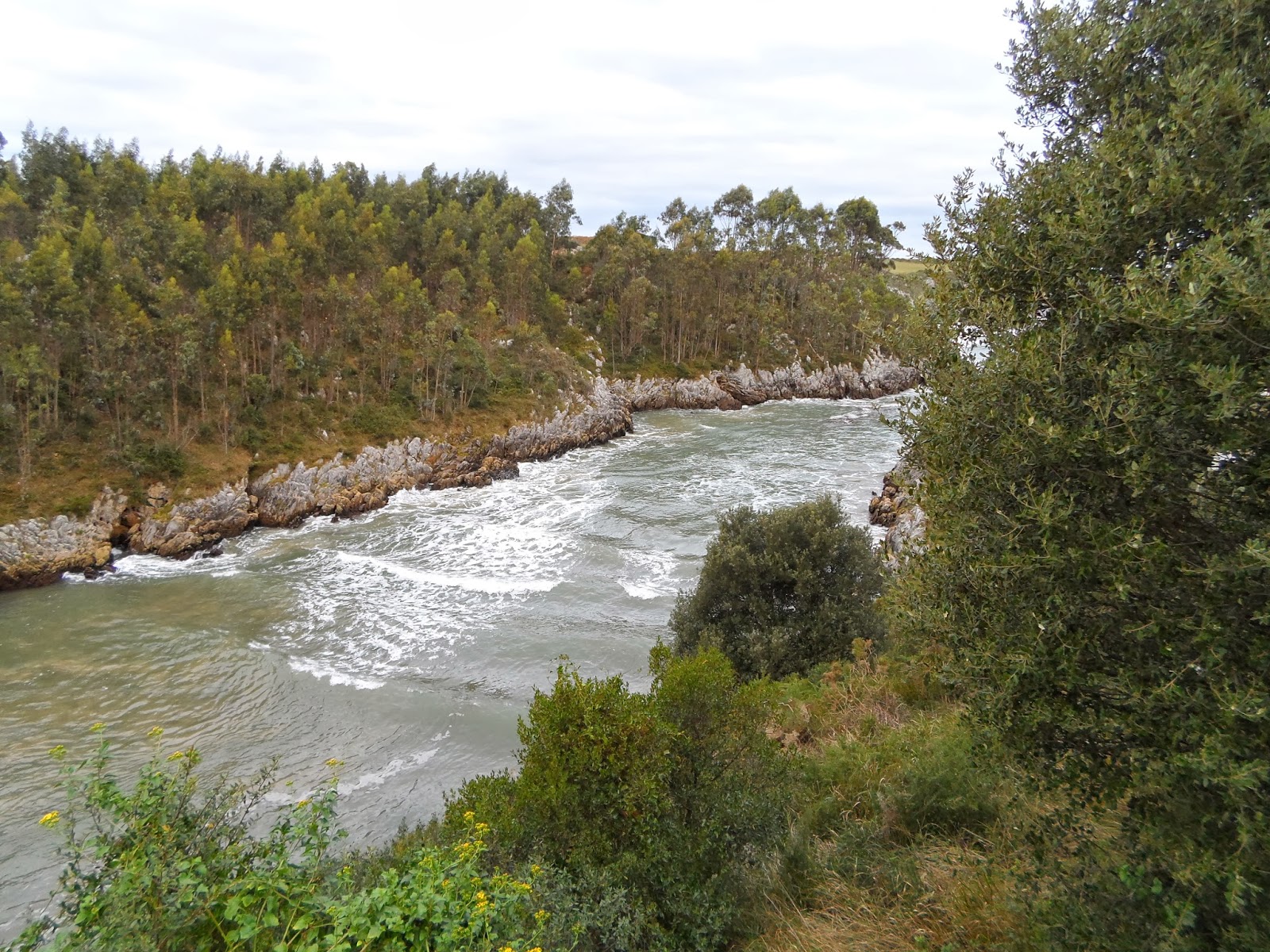
The third surprise. We headed off the motorway - not long after rejoining it when we emerged from the Picos - and stopped at this coastal viewing point, just east of the town of Llanes. 


And then the fourth surprise. We spent a couple hours meandering around Llanes, which  was founded in the 13th century and is as pleasing a spot as I ever have visited. Ancient and lovely. I certainly must return there for a day (at least) in the spring.
 
The port. 

 
Plaza de Cimadevilla, in the medieval quarter.

 
Plaza de Santa Ana (through the passageway behind Marivi in the photo above). The salmonish-colored building is the Palacio de Gastaña. It is the oldest non-clerical building in the town, dating from the 14th century.


Capilla de Santa Ana (15th century), on the other side of the square, opposite the Palacio.
 

A palacio on the Calle Mayor, leaving the Plaza de Santa Ana.

 
Santa María del Conceyu Basilica (13th-15th centuries).


And the Camino runs through the town.

 
The medieval watch tower, decorated for Christmas.


Sunday, January 26, 2014

A weekend of Asturian culture and history

9-10.11.2013

The weekend of 9-10 November overflowed with Asturian culture and history. From Friday to Sunday, "Xi Seronda n'Avilés," a traditional Fall festival , celebrated the arrival of chestnuts and cider with much traditional Asturian dancing and bagpipe music - and, of course, food and cider. And then, on Sunday, I visited Covadonga - arguably the most historically-significant site in Asturias - with cousin Jorge. Delightfully, we were accompanied by Julio, a long-time friend of Jorge and Jorge's father, and my daily companion at the library café (I work; Julio smokes a cigar, completes the crossword puzzle in the local newspaper and regales the university students with stories). Nearly from the day I arrived, people (including Julio) asked whether I had been to Covadaonga yet, and urged me to go as soon as possible when I admitted I had not. I jumped at the chance when Jorge, who had stopped by the library café for a coffee and chat, offered to take us there. 

First, a little historical background. In 718, the Asturian (perhaps Visigoth) leader Don Pelayo and his band of guerilla fighters were hiding in a cave at Covadonga, in the Cantabrian Mountains (to the southeast of Avilés). Beneath them were soldiers of the Ummayad Caliphate (the Muslim kingdom which by that point covered all of what is now Spain, except for Asturias). According to the legend, the Virgin Mary appeared to Don Pelayo, saying that if he rallied his men and carried the priest's wooden cross into battle against the Moors, she would ensure them victory. Divine visitation or not, Don Pelayo and his men bombarded the Muslim soldiers with stones from the cave and then engaged them in battle, forcing their retreat back south of the mountains. It marks the beginning of the Kingdom of Asturias (718-924) and the start of the Reconquista. The Virgin of Covadonga became the patron saint of Asturias, and she is everywhere today: statues in churches, all manner of tourist kitsch, plaques on private homes in the countryside.

But before we headed inland to Covadonga, Jorge had a surprise (as, I have discovered, usually is the case when he plans an excursion). We passed the exit for Covadonga, left the motorway and wended our way through villages along roads barely as wide as the car to the coast, to the Bufones de Pría.

Bufones occur all along this stretch of the coast. They are similar to geysers, except that they are formed by seawater being pushed up vents to the surface from subterranean caves down where the crags meet the sea. They depend entirely upon the weather and water conditions (big waves, stiff wind blowing inland), which usually are best in the morning. I had wondered why Jorge had such a sense of urgency about our early departure. 


The mouth of the inlet which goes back to the small beach of Pría, a couple hundred yards behind, where we left the car and continued on foot to the bufones (below).


Signs warn not to stick your head over the hole, lest you catch a stone flying up along with the seawater (and sand, I discovered, when I was downwind from one eruption). When the water comes up, it is preceded by a blast of air, and it sounds like a dragon exhaling.
 
Here is a link to video I took. Jorge seemed to be disappointed by the force of the eruptions (on some days they shoot up like geysers at Yellowstone), but I thought it was dramatic and impressive. It was a wonderful surprise.


The bluffs, looking to the east.


As close to the edge as I had courage to go.

 
With Julio.

 
Julio and Jorge.

 
I think something is happening behind me.

 
Description of the bufones.


The inlet, just above the beach. A bit more placid.


On the way to Covadonga, we stopped again in the town of Cangas de Onís, which was the first capital of the Kingdom of Asturias, to see the Puente Romano. The stone bridge crosses the Ría Sella and was constructed in the 13th century. Its name comes from the fact that a Roman bridge was located at the same point, along the road connecting the Roman cities of Lucus Asturum (near modern-day Oviedo) and Portus Victoriae (modern-day Santander). Hanging in the center arch is a copy of the Victory Cross, the gilded and jeweled wooden cross Don Pelayo reputedly carried into the Battle of Covadonga. The Victory Cross is housed at the Camera Santa in Oviedo Cathedral and is represented on the Asturian flag. The Ría Sella is crystal-clear and a very popular spot for salmon fishing.


After a quick coffee in Canga de Onís, and the carbayones (a heavenly, classic Asturian almond-paste pastry) I had brought from Avilés, we raced to Covadonga for the noon pilgrim mass, which features the excellent boys choir from the Basilica school.

 
The cave, from across the small valley at the Basilica.


The cave, Moorish perspective.


Don Pelayo, outside the Basilica.


The Basilica (19th century).


In the tunnel leading to the cave. No photography was allowed in the cave itself, where there is a small chapel and a giant Virgin of Covadonga, from which is suspended a silver amulet which the faithful kiss (and deposit a euro in the box). To see that, you must come to Asturias!

 
Santa Cruz Chapel in Cangas de Onís. King Favila, the son of Don Pelayo, ordered the chapel built in 737 to venerate the Victory Cross. It was completely rebuilt in 1637, and then again in 1936, after it was destroyed in the civil war. To practice your Castilian, the explanatory sign is below.


On Saturday night, I went to the tent set up in the courtyard beside the library for the Seronda festivities (and some roasted chestnuts and sidra dulce, the thick, sweet, flavorful, unfermented new apple cider). This is one of the traditional troupes that participated, and they danced and sang to bagpipe music for two straight hours.

 
Links to some video of the dancing.


I also had a great, greasy helping of cornmeal tostada with fried meat (being prepared here) and topped with sharp, melted goat cheese. Magnificent.