Sunday, April 20, 2014

Cabo Vidio and Cudillero

Cabo Vidio and Cudillero
16.2.2014
Jorge and Marivi seized a spring-like mid-February Sunday for an excursion along the coast to the west about 15 miles. It was yet another lovely day. 
First, we stopped at Cabo (Cape) Vidio, which was spectacular. The Cabo juts out dramatically from the coastline, with 275-foot drops to the sea and a lighthouse perched on its crest.
 
Cabo Vidio and the lighthouse.
 
 
Views as we walked around the tip of the Cabo.


Vidio video.
 
 
Then we drove inland a few miles and took a very nice hike up into the hills through the pine forests, with magnificent views of the sea, mountains and Cabo Vidio from the top.
 
On the ascent.


This is a good distance from neighbors, and about as great as a view can get.


The view from the top, looking toward Cudillero.


Cabo Vidio.


Looking south toward the snow-covered mountains.


Jorge and Marivi at the top. The building is part of the coastal forest fire patrol.


Some Asturian guy.


On the descent.


We finished the day in the old town of Cudillero, a seaside village which dates at least to the 13th  century (one legend has that it was founded by the Vikings). The historic center is roughly U-shaped and occupies a small, steeply-walled cove. Built around fishing and salt, the village now principally lives on tourism, though it still has a small fleet of pescadores. Our warm February day was perfect for a visit, well before the season of the tourist hoard. We sat in the sun, eating grilled chiperones (medium-sized, whole squid), drinking sidra (which Jorge, the authentic Asturian, poured expertly) and enjoying the view of the brightly-colored buildings scaling the hillsides. It felt as if we were sitting in a Roman theater, and the buildings appeared to have sprung up from the ground like wildflowers.
 
The old port.
 
 
The old town.


The Cudillero lighthouse (Faro de Cudillero).


The new (early-20th century) port.


That missing section of the seawall that protects the port was knocked down about three weeks before our visit, when the Galician and Asturian coasts were pounded by 30-foot waves and gale-force winds for days on end.


Friday, April 18, 2014

La Navidad asturiana


The Christmas season here, as in Europe generally, begins on St. Nicholas Day, December 6. I went to the mass at San Nicolás de Bari Church in Avilés, which was followed by the procession of the saint. Led by the priests and altar boys and girls, and followed by the Avilés municipal band, parishioners carried the wooden statue of St. Nicolás on a flower-covered platform from the church, across Plaza de España and through the streets of the old town. It was a beautiful way to start the season.
 
The nave and main altar in the church.

 
Video of the procession.  


The Ayuntamiento (municipal hall) and decorations in Plaza de España.


My street, Calle Rivero.


Calle La Fruta.


Calle La Cámera.


Plaza de Carbayedo (now a park, until the 1940s, the livestock market).


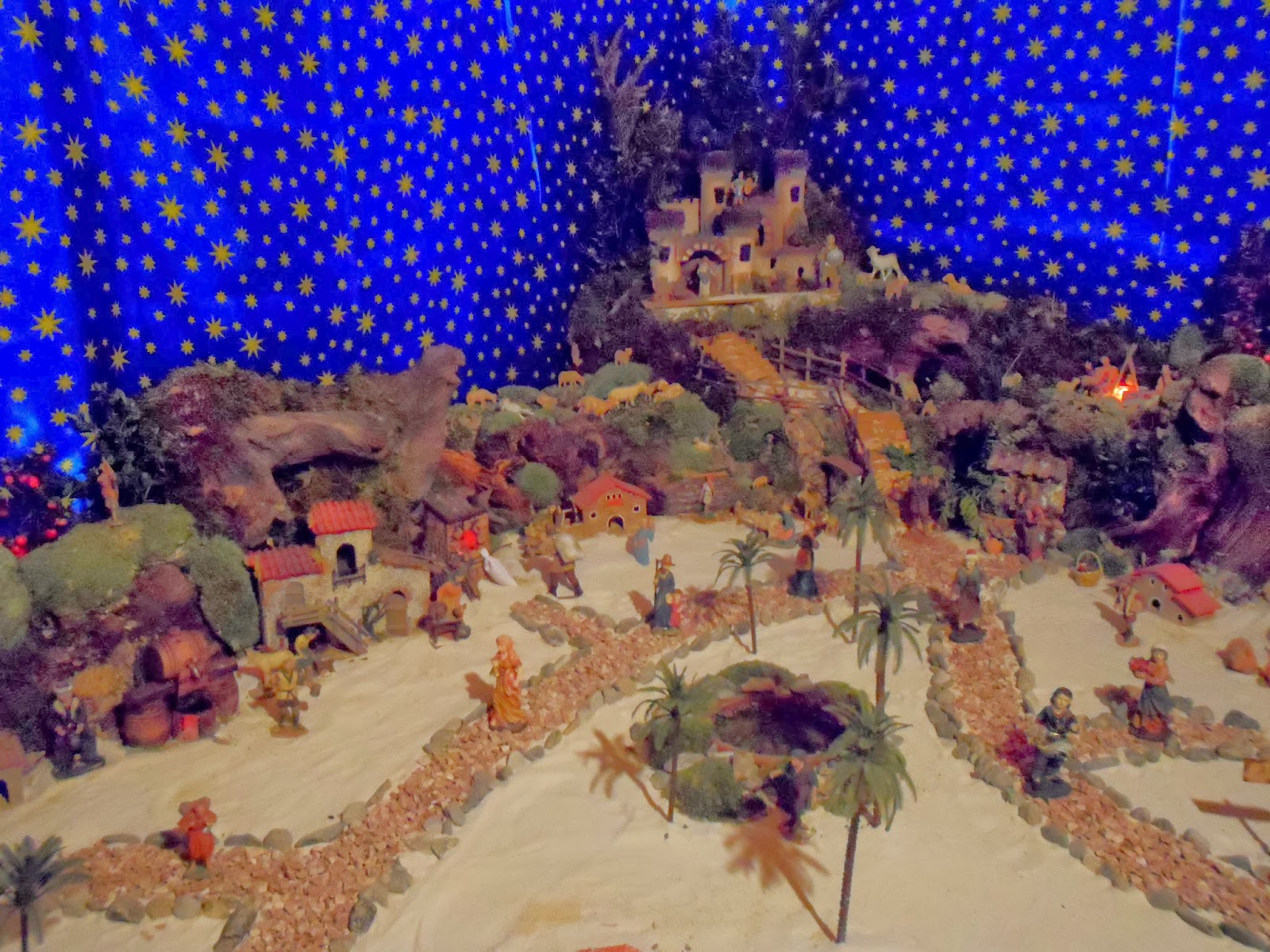
The Nativity Scene (called a Belén in Spain) is the primary Christmas decoration in the home, rather than the north European and North American Christmas tree. They often are mind-bogglingly elaborate. I know one man who devotes an entire room to his and leaves it up all year. Avilés even used to sponsor a competition. Judges would come to people’s houses and give out awards for the best creations. It can take weeks to put them together, starting with the construction of greenery-covered hills. Families often add a piece or two each year, and have for generations, so it just keeps growing. The Belén always includes the traditional manger arrangement, of course, but it also has scenes from local, rural daily life: farmhouses, hórreos (in Asturias), gardens, livestock, rivers, ponds, fountains, wells, windmills – just about anything you can imagine.
 
Cousin María Esther and her family build an enormous, traditional Belén in their house near Naveces every year (starting in October). Antonio took me out to see it, and it was absolutely astounding. It even had a cascade and river with flowing water. It takes up half a room.


The video captures it better than the photos, though it still is too short a look. I could have stood there for an hour examining each detail.


Saturday, February 1, 2014

Los Picos de Europa

 
7.12.2014

The first weekend in December, I ventured out to the Picos de Europa, courtesy of cousin Jorge and his wife Marivi. It was a grand day, full of nature and surprises.

The Picos is a compact range in the Cantabrian Mountains, just inland to the east of Avilés, and the mostly-limestone peaks stretch across parts of Asturias, Cantabria and Castile. They are one of the wonders of this part of Spain. When we got our first full glimpse of them, I felt like I was back in Südtirol. Our destination was Fuente Dé, in the western-most part of the Picos in Cantabria. We could not have asked for more perfect weather, bracingly cold and clear blue skies. It even had snowed that week in the high altitudes. Though our planned hike was abbreviated - we did not have gear for tromping through knee-deep snow - we were more than compensated by the magnificent winter vistas. 

After wending our way inland on a narrow road snaking through the steep foothills, we got our first full look at the Picos as we passed through the medieval town of Potes, which now is a major center of hiking and mountaineering. We stopped for a photo, and I noticed this statue of a Camino de Santiago pilgrim just across the road.


Los Picos at Fuente Dé


We caught the Teleférico de Fuente Dé (constructed in 1966, 1450m long, 753m ascent) up to the plateau.


Marivi and Jorge, at the visitor's center on the upper end of the Teleférico


We were determined to get at least a little hiking, as far as we could in the snow, and headed off across the plateau.


Marivi had brought pinchos for a snack for us, and we stopped here, with a lovely view of Peña Vieja (2614m), to eat them before heading back toward the Teleférico.


Back down to where the trees grow.

 
The first surprise (though it should not have been). As usual, Jorge had found a perfect place for our late lunch: the restaurant Vicente Campo in the nearby hamlet of Espinama. It was perfect, with thick stone walls, beamed ceilings, excellent traditional local food, and this view from the upper dining room.


After stuffing ourselves with enough food to fuel a Picos shepherd for a couple days, we took a stroll around Espinama, which looks as if it were carved from the hilltop. Vicente Campo is in the uppermost building on the right.


The second surprise of the day: the preromanesque Church of Santa María de Lebeña, one of the oldest churches in Cantabria. Marivi and I went in for the very detailed tour of the starkly beautiful interior. Unfortunately, no photos allowed, so it is another thing you will have to come to Asturias to see!


The third surprise. We headed off the motorway - not long after rejoining it when we emerged from the Picos - and stopped at this coastal viewing point, just east of the town of Llanes. 


And then the fourth surprise. We spent a couple hours meandering around Llanes, which  was founded in the 13th century and is as pleasing a spot as I ever have visited. Ancient and lovely. I certainly must return there for a day (at least) in the spring.
 
The port. 

 
Plaza de Cimadevilla, in the medieval quarter.

 
Plaza de Santa Ana (through the passageway behind Marivi in the photo above). The salmonish-colored building is the Palacio de Gastaña. It is the oldest non-clerical building in the town, dating from the 14th century.


Capilla de Santa Ana (15th century), on the other side of the square, opposite the Palacio.
 

A palacio on the Calle Mayor, leaving the Plaza de Santa Ana.

 
Santa María del Conceyu Basilica (13th-15th centuries).


And the Camino runs through the town.

 
The medieval watch tower, decorated for Christmas.